Toward sustainable ROI governance in marketing: Integrating multi-touch attribution and incrementality testing for evidence-based budget decisions
Article Sidebar
Main Article Content
Abstract
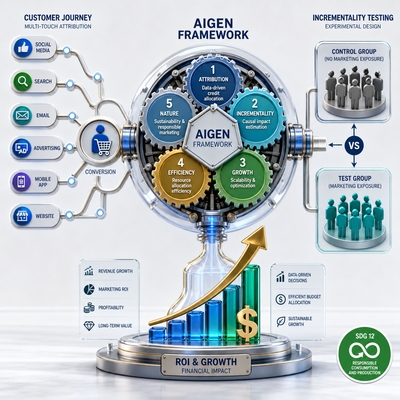
Purpose. This paper addresses the methodological misalignment between descriptive multi-touch attribution and causal incrementality testing within marketing ROI governance. It argues for an integrative framework where both approaches serve as complementary mechanisms rather than competing instruments, ensuring responsible resource allocation and sustainable corporate budgeting aligned with long-term organizational accountability. Methodology. The study adopts a conceptual-analytical design grounded in a structured synthesis of literature on multichannel advertising response, digital experimentation, and causal evaluation. To validate the practical utility of the proposed framework and bring its empirical boundaries into focus, a hypothetical simulation based on industry benchmark patterns is constructed. This scenario demonstrates how conventional rules-based attribution methods misallocate value and distort advisory ROI when specific strategic media levers are modified. Results. The simulation highlights a systematic attribution bias: last-touch and time-decay models overallocate credit to lower-funnel channels near the conversion event by approximately one-third, consistently undervaluing upper-funnel awareness and lifecycle interventions. The proposed five-phase Attribution Integration & Governance Engine (AIGEN) framework corrects these distortions by balancing path-based diagnostics with selective counterfactual validation, establishing a transparent, finance-ready bridge to contribution margins. Theoretical contribution. This research bridges the gap between descriptive and causal inference paradigms within marketing productivity literature. It operationalizes this synthesis into a transferable decision architecture that conceptualizes performance measurement not as an isolated reporting metric, but as an ongoing system of evidence-based organizational learning and sustainable business governance. Practical implications. For management consultants and corporate marketing analytics teams, the AIGEN framework provides an auditable protocol that moves beyond superficial dashboard reporting toward causally disciplined resource allocation. This shift directly improves the fiscal sustainability, transparency, and ethical compliance of digital advertising investments within modern, privacy-constrained corporate structures.
Sustainable Development Goals (SDGs): SDG 12: Responsible Consumption and Production
Downloads
Article Details

This work is licensed under a Creative Commons Attribution 4.0 International License.
This work (article) is licensed under a Creative Commons Attribution 4.0 International License.
References
Ambler, T. (2000). Marketing metrics: What should we tell the shareholders? Journal of Marketing Management, 16(1–3), 59–71. https://doi.org/10.1504/IJBPM.2000.000065
Anderl, E., Becker, I., von Wangenheim, F., & Schumann, J. H. (2016). Mapping the customer journey: A graph-based framework for online attribution modeling. International Journal of Research in Marketing, 33(3), 457–474. https://doi.org/10.1016/j.ijresmar.2016.03.001
Aridor, G., Che, Y.-K., Nelson, W., & Salz, T. (2020). The economic consequences of data privacy regulation: Empirical evidence from GDPR. SSRN Electronic Journal. https://doi.org/10.2139/ssrn.3522845
Berman, R. (2018). Beyond the last touch: Attribution in online advertising. Marketing Science, 37(5), 771–792. https://doi.org/10.1287/mksc.2018.1104
Dalessandro, B., Perlich, C., Stitelman, O., & Provost, F. (2012). Causally motivated attribution for online advertising. In Proceedings of the Sixth International Workshop on Data Mining for Online Advertising and Internet Economy (ADKDD ’12). Association for Computing Machinery. https://doi.org/10.1145/2351356.2351363
Danaher, P. J., & van Heerde, H. J. (2018). Delusion in attribution: Caveats in using attribution for media budget allocation. Journal of Marketing Research, 55(5), 667–685. https://doi.org/10.1177/0022243718802845
Deloitte Digital. (2025). Marketing trends of 2025: Embracing change and gearing up for the future. Deloitte.
Farris, P. W., Bendle, N. T., Pfeifer, P. E., & Reibstein, D. J. (2010). Marketing metrics: The definitive guide to measuring marketing performance (2nd ed.). Pearson.
Fornell, C., Mithas, S., Morgeson, F. V., & Krishnan, M. S. (2006). Customer satisfaction and stock prices: High returns, low risk. Journal of Marketing, 70(1), 3–14. https://doi.org/10.1509/jmkg.70.1.003.qxd
Gartner. (2025). Annual CMO spend survey data snapshots: Strategic insights for CMOs. Gartner.
HubSpot. (2025). 2025 state of marketing report. HubSpot.
Johnson, G. A., Shriver, S. K., & Du, S. (2020). Consumer privacy choice in online advertising: Who opts out and at what cost to industry? Marketing Science, 39(1), 33–51. https://doi.org/10.2139/ssrn.3020503
Lemon, K. N., & Verhoef, P. C. (2016). Understanding customer experience throughout the customer journey. Journal of Marketing, 80(6), 69–96. https://doi.org/10.1509/jm.15.0420
Lim, W. M. (2016). A blueprint for sustainability marketing: Defining its conceptual boundaries for progress. Marketing Theory, 16(2), 232–249. https://doi.org/10.1177/1470593115609796
Ling-yee, L. (2011). Marketing metrics’ usage: Its predictors and implications for customer relationship management performance. Industrial Marketing Management, 40(1), 139–148. https://doi.org/10.1016/j.indmarman.2010.09.002
Marketing AI Institute. (2025). State of marketing AI report 2025. Marketing AI Institute.
O’Sullivan, D., & Abela, A. V. (2007). Marketing performance measurement ability and firm performance. Journal of Marketing, 71(2), 79–93. https://doi.org/10.1509/jmkg.71.2.079
Rafieian, O., & Yoganarasimhan, H. (2018). Targeting and privacy in mobile advertising. SSRN Electronic Journal. https://doi.org/10.2139/ssrn.3163806
Rust, R. T., Lemon, K. N., & Zeithaml, V. A. (2004). Return on marketing: Using customer equity to focus marketing strategy. Journal of Marketing, 68(1), 109–127. https://doi.org/10.1509/jmkg.68.1.109.24030
Salesforce. (2024). State of marketing (10th ed.). Salesforce.
Seggie, S. H., Cavusgil, E., & Phelan, S. E. (2007). Measurement of return on marketing investment: A conceptual framework and the future of marketing metrics. Industrial Marketing Management, 36(6), 834–841. https://doi.org/10.1016/j.indmarman.2006.11.001
Shao, X., & Li, L. (2011). Data-driven multi-touch attribution models. In Proceedings of the 17th ACM SIGKDD International Conference on Knowledge Discovery and Data Mining (pp. 258–264). Association for Computing Machinery.
Silva, S. C., Borges, A. P., Silva, L. L., & Pereira, F. (2023). Marketing accountability and marketing automation: Evidence from Portugal. EuroMed Journal of Business, 18(3), 365–388. https://doi.org/10.1108/EMJB-11-2020-0117
Wedel, M., & Kannan, P. K. (2016). Marketing analytics for data-rich environments. Journal of Marketing, 80(6), 97–121. https://doi.org/10.1509/jm.15.0413
White, K., Habib, R., & Hardisty, D. J. (2019). How to SHIFT consumer behaviors to be more sustainable: A literature review and guiding framework. Journal of Marketing, 83(6), 22–49. https://doi.org/10.1177/0022242919825649