HR analytics for evidence-based people management: A structured synthesis of methods, decision interfaces, and governance principles for sustainable organizations
Article Sidebar
Main Article Content
Abstract
Purpose. This study synthesizes empirical and methodological evidence on human resource data analytics to provide a practical, decision-oriented blueprint for people management aligned with the United Nations Sustainable Development Goals (SDGs).
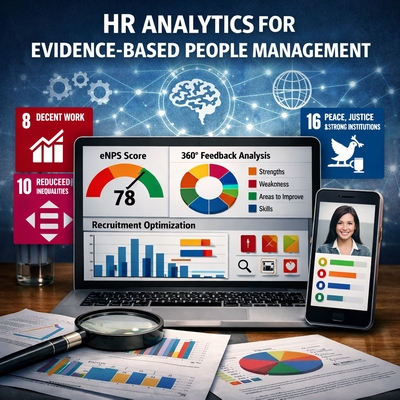
Methodology. An integrative, PRISMA-compliant systematic review of 20 highly relevant peer-reviewed sources published between 2021 and 2026 was conducted. The synthesis evaluates three core analytical workstreams – Employee Net Promoter Score (eNPS) monitoring, 360-degree feedback, and prescriptive recruitment optimization – mapping extracted evidence onto specific decision interfaces. Due to the methodological heterogeneity of the corpus, a structured narrative synthesis was utilized to evaluate the alignment of data-driven interventions with sustainability targets.
Results. Descriptive metrics such as eNPS function most effectively as continuous early-warning signals for retention intention rather than isolated diagnostic tools. Multi-rater 360-degree feedback yields reliable developmental signals exclusively when embedded in structured programs and structurally decoupled from compensation decisions. Furthermore, prescriptive optimization in recruitment generates measurable operational gains, particularly when algorithmic fairness mandates, budget constraints, and organizational capacity limits actively constrain predictive algorithms.
Theoretical contribution. The study advances a structured analytical pipeline that bridges the operational gap between technical predictive modeling and corporate social responsibility. It establishes ethical data governance and epistemic alignment as mandatory preconditions for deploying advanced people analytics, integrating previously fragmented literature on digital human resource transformation.
Practical implications. Organizations can implement the proposed five-stage blueprint - defining business objectives, specifying decision points, selecting minimal viable data, validating on decision horizons, and embedding governance rails – to convert raw workforce data into traceable, repeatable interventions. This framework directly supports the promotion of decent work (SDG 8), the reduction of algorithmic inequalities (SDG 10), and the establishment of transparent, accountable institutional data governance (SDG 16).
SDG 8: Decent Work and Economic Growth; SDG 10: Reduced Inequalities; SDG 16: Peace, Justice and Strong Institutions
Downloads
Article Details

This work is licensed under a Creative Commons Attribution 4.0 International License.
This work (article) is licensed under a Creative Commons Attribution 4.0 International License.
References
Bhokare, A. S., Hakweenda, H., Kulkarni, P., Thanekar, S. S., & Dayma, H. S. (2026). Mapping the intellectual structure of HR analytics and sustainability performance - A bibliometric analysis using the Dimensions database. SHS Web of Conferences, 230, 05001. https://doi.org/10.1051/shsconf/202623005001
Bonilla-Chaves, E. F., & Palos-Sánchez, P. R. (2023). Exploring the evolution of human resource analytics: a bibliometric study. Behavioral Sciences, 13(3), 244. https://doi.org/10.3390/bs13030244
Chang, Y. L., & Ke, J. (2024). Socially Responsible Artificial Intelligence Empowered People Analytics: A Novel Framework Towards Sustainability. Human Resource Development Review, 23(1), 88–120. https://doi.org/10.1177/15344843231200930
Christina, J., Alamelu, R., & Nigama, K. (2025). Synthesizing the impact of sustainable human resource management on corporate sustainability through multi method evidence. Discover Sustainability, 6(1). https://doi.org/10.1007/s43621-025-01557-3
Ezeafulukwe, C., Okatta, C. G., & Ayanponle, L. (2022). Frameworks for sustainable human resource management: Integrating ethics, CSR, and Data-Driven Insights. World Journal of Advanced Research and Reviews, 13(3), 583–592. https://doi.org/10.30574/wjarr.2022.13.3.0151
Faisal, S. (2023). Twenty-Years Journey of Sustainable Human Resource Management Research: A Bibliometric Analysis. Administrative Sciences, 13(6), 139. https://doi.org/10.3390/admsci13060139
Gaurav, A., Gupta, B. B., Attar, R., Arya, V., Alhomoud, A., Chen, M. Y., & Nedjah, N. (2025). Data-Driven Exploration of Emerging Trends in Sustainable Human Resource Management Using Advanced Analytics. International Journal of Data Warehousing and Mining, 21(1), 1–15. https://doi.org/10.4018/ijdwm.368722
Goswami, T. G. (2025). Human Resource Analytics: A Hybrid Review. South Asian Journal of Human Resources Management. https://doi.org/10.1177/23220937251322236
Kainzbauer, A., Rungruang, P., & Hallinger, P. (2021). How Does Research on Sustainable Human Resource Management Contribute to Corporate Sustainability: A Document Co-Citation Analysis, 1982–2021. Sustainability, 13(21), 11745. https://doi.org/10.3390/su132111745
Kumar, M., Manglani, H., & Jadhav, J. (2024). Unveiling Research Trends on the Sustainable Development Goals: A Systematic Bibliometric Review. International Journal of Sustainable Development and Planning, 19(5), 1723–1733. https://doi.org/10.18280/ijsdp.190510
Kushwaha, V., Hasnaoui, A., Hachard, V., & Kumar, M. (2026). Human resource analytics, ESG integration and sustainable value creation in small business communities. Journal of Enterprising Communities: People and Places in the Global Economy, 1–14. https://doi.org/10.1108/jec-05-2025-0162
Margherita, A. (2022). Human resources analytics: A systematization of research topics and directions for future research. Human Resource Management Review, 32(2), 100795. https://doi.org/10.1016/j.hrmr.2020.100795
Raman, R., Lathabhai, H., Pattnaik, D., Kumar, C., & Nedungadi, P. (2024). Research contribution of bibliometric studies related to sustainable development goals and sustainability. Discover Sustainability, 5(1). https://doi.org/10.1007/s43621-024-00182-w
Shahid, S., Kaur, K., Patel, P., Kumar, S., & Prikshat, V. (2025). Integrating sustainable development goals into HRM in emerging markets: an empirical investigation of Indian and Chinese banks. International Journal of Manpower, 46(4), 792–815. https://doi.org/10.1108/ijm-01-2024-0075
Siddique, N., Naveed, S., & Inam, A. (2025). A bibliometric review on sustainable human resource management (1982–2023). Journal of Organizational Effectiveness: People and Performance, 12(1), 14–36. https://doi.org/10.1108/joepp-09-2023-0432
Tahir, A. H., Umer, M., Nauman, S., Abbass, K., & Song, H. (2024). Sustainable development goals and green human resource management: A comprehensive review of environmental performance. Journal of Environmental Management, 370, 122495. https://doi.org/10.1016/j.jenvman.2024.122495
Thakral, P., Srivastava, P., Dash, S., Jasimuddin, S., & Zhang, Z. (2023). Trends in the thematic landscape of HR analytics research: a structural topic modeling approach. Management Decision, 61(12), 3665–3690. https://doi.org/10.1108/md-01-2023-0080
Tomer, T., & Tyagi, P. (2026). “Innovative Approaches to Sustainability in Human Resource Management: A Review of Strategies, Challenges, and Future Directions”. International Journal of Latest Technology in Engineering Management & Applied Science, 15(2), 724–742. https://doi.org/10.51583/ijltemas.2026.15020000063
Yin, J. (2025). Sustainable HRM in the age of analytics: capabilities, risks and a path forward. Employee Relations: The International Journal, 1–24. https://doi.org/10.1108/er-12-2024-0786
Yoon, S. W., Han, S., & Chae, C. (2024). People Analytics and Human Resource Development – Research Landscape and Future Needs Based on Bibliometrics and Scoping Review. Human Resource Development Review, 23(1), 30–57. https://doi.org/10.1177/15344843231209362