Sustainable human capital allocation in professional services: An integrated predictive scoring architecture for capacity-constrained lead governance
Article Sidebar
Main Article Content
Abstract
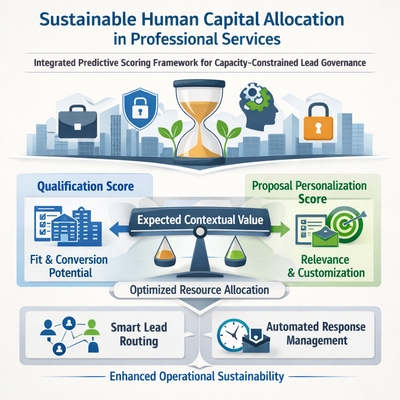
Purpose. This paper addresses the critical intersection of operational capacity bottlenecks and data degradation in contemporary business governance. In the privacy-preserving market landscape of 2025–2026, professional service organizations face a dual challenge: the loss of third-party behavioral signals and the accelerating depletion of expert human capital. This study synthesizes lead qualification and proposal personalization into a unified, auditable resource governance framework designed to optimize internal operational sustainability. Methodology. The research employs a conceptual-analytical research design grounded in a structured evidence synthesis of twenty core academic and industry sources spanning predictive analytics, sales-funnel optimization, and organizational workflow management. The scoring mechanism’s parameters are conceptually bounded by real-world operational considerations derived from recent global human capital evaluations and data privacy benchmarks. Proposed framework. The framework proposes an integrated dual-component algorithm that simultaneously evaluates a Qualification Score, reflecting corporate alignment and conversion probability, and a Proposal Personalization Score, indicating signal-to-module thematic fit. By combining these metrics into an Expected Contextual Value framework, the system transitions from traditional diagnostic labels to direct operational interventions, including dynamic routing and automated response-time thresholds. Theoretical contribution. This study expands the theoretical boundaries of sales-funnel modeling by embedding multi-criteria decision-making within environments characterized by restricted customer tracking data. It explicitly shifts the evaluation paradigm from isolated statistical accuracy to systemic conversion uplift, filling a persistent gap in quantitative marketing literature. Practical implications. For executive practitioners and internal analytics teams within consulting networks, the proposed framework establishes a transparent blueprint for CRM implementation. The architecture directly mitigates the risks of professional burnout and misallocated labor hours, ensuring long-term corporate viability through disciplined data governance.
Sustainable Development Goals (SDGs): SDG 8: Decent Work and Economic Growth; SDG 9: Industry, Innovation and Infrastructure
Downloads
Article Details

This work is licensed under a Creative Commons Attribution 4.0 International License.
This work (article) is licensed under a Creative Commons Attribution 4.0 International License.
References
Thought Marketing. (2026). Privacy Standards for Marketers: Navigating Compliance in 2026. https://4thoughtmarketing.com/articles/privacy-standards-for-marketers/
Davenport, T., Guha, A., Grewal, D., & Bressgott, T. (2020). How artificial intelligence will change the future of marketing. Journal of the Academy of Marketing Science, 48(1), 24–42. https://doi.org/10.1007/s11747-019-00696-0
Đorđević, A. (2019). Optimization of digital marketing processes through modeling of lead-scoring. In Sinteza 2019 - International Scientific Conference on Information Technology and Data Related Research (pp. 32-37). https://doi.org/10.15308/Sinteza-2019-32-37
Duncan, B. A., & Elkan, C. P. (2015). Probabilistic modeling of a sales funnel to prioritize leads. In Proceedings of the 21st ACM SIGKDD International Conference on Knowledge Discovery and Data Mining (KDD’ 15) (pp. 1751-1758). Association for Computing Machinery. https://doi.org/10.1145/2783258.2788578
Eitle, V., & Buxmann, P. (2019). Business analytics for sales pipeline management: The case of the B2B sales funnel. In Proceedings of the 52nd Hawaii International Conference on System Sciences (pp. 1015-1024). https://doi.org/10.24251/HICSS.2019.125
Espadinha-Cruz, P., Fernandes, S., & Grilo, A. (2021). Lead management optimization using data mining: A case in the telecommunications sector. Computers & Industrial Engineering, 154, 107122. https://doi.org/10.1016/j.cie.2021.107122
González-Flores, E., Bilbao-Terol, A., Jiménez-Ordaz, M., & Arenas-Parra, M. (2025). The relevance of lead prioritization: Development and evaluation of a lead scoring model. Frontiers in Artificial Intelligence, 8, 1554325. https://doi.org/10.3389/frai.2025.1554325
Gouveia, D., & Costa, M. (2022). Industry 4.0: Predicting lead conversion opportunities with machine learning in small and medium sized enterprises. Procedia Computer Science, 204, 310-317. https://doi.org/10.1016/j.procs.2022.08.038
HubSpot. (2025). The 2025 state of marketing report. HubSpot.
Jadli, F., Mustapha, A., Hasbaoui, M., & Slimani, E. (2023). Artificial intelligence-based lead propensity prediction. International Journal of Artificial Intelligence, 12(3), 1281-1290. https://doi.org/10.11591/ijai.v12.i3.pp1281-1290
Järvinen, J., & Taiminen, H. (2016). Harnessing marketing automation for B2B content marketing. Industrial Marketing Management, 54, 164-175. https://doi.org/10.1016/j.indmarman.2015.10.002
Kotler, P., Rackham, N., & Krishnaswamy, S. (2006). Ending the war between sales and marketing. Harvard Business Review, 84(7-8), 68-78. PMID: 16846190
LinkedIn Sales Solutions, & Ipsos. (2024). Sales leader compass: Navigating the path to future ready. LinkedIn.
Marketing AI Institute, & SmarterX. (2025). The 2025 state of marketing AI report. Marketing AI Institute.
McKinsey & Company. (2026). The State of Organizations 2026: Sustained performance and long-term value creation. https://www.mckinsey.com/~/media/mckinsey/business%20functions/people%20and%20organizational%20performance/our%20insights/the%20state%20of%20organizations/2026/the-state-of-organizations-2026.pdf
Mezei, J., & Nygård, J. F. (2020). Automating lead scoring with machine learning: An experimental study. In Proceedings of the 53rd Hawaii International Conference on System Sciences. https://doi.org/10.24251/HICSS.2020.177
Monat, J. P. (2011). Industrial sales lead conversion modeling. Marketing Intelligence & Planning, 29(3), 252-264. https://doi.org/10.1108/02634501111117538
Good, V., Bhattacharya, A., Hochstein, B. W., & Voorhees, C. M. (2025). Determining the quality of B2C sales leads from online chats. International Journal of Research in Marketing, 43(2), Part A, 383-403. https://doi.org/10.1016/j.ijresmar.2025.07.001
Ohiomah, A., Andreev, P., & Benyoucef, M. (2019). The role of lead management systems in inside sales performance. Journal of Business Research, 101, 532-542. https://doi.org/10.1016/j.jbusres.2018.11.045
Poynton, S., Flynn, J., Scoble-Williams, N., Reyes, V., Mallon, D., & Cantrell, S. (2026, March 4). 2026 Global Human Capital Trends. https://www.deloitte.com/us/en/insights/topics/talent/human-capital-trends.html
Salesforce. (2024). State of marketing (9th ed.). Salesforce.
Singh, M. (2024). Privacy-preserving marketing analytics: Navigating the future of cookieless tracking. International Journal of Enhanced Research in Management & Computer Applications, 13, 2319-7471.
Smith, P. (2022). Digital Marketing Excellence: Planning, Optimizing and Integrating Online Marketing (6th ed.). Routledge. https://doi.org/10.4324/9781003009498
Stadlmann, M., & Zehetner, J. (2022). Comparing AI-based and traditional prospect generating methods. Journal of Promotion Management, 28(1), 11-31. https://doi.org/10.1080/10496491.2021.1997798
Wu, K., Fang, X., & Guo, Y. (2024). The state of lead scoring models and their impact on sales performance: A systematic review. Information Technology & Management, 25(1), 69-98. https://doi.org/10.1007/s10799-023-00388-w