Robot taxation as a fiscal policy instrument for sustainable employment: A scoping review with implications for developing economies
Article Sidebar
Main Article Content
Abstract
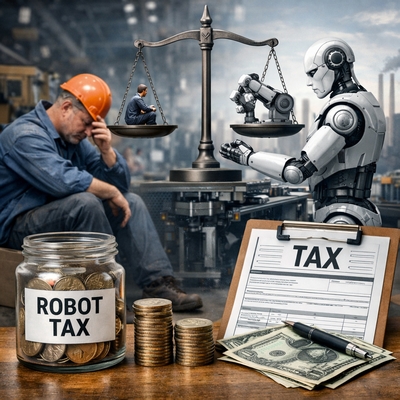
Purpose: Automation often displaces workers without adequate retraining, leading to unemployment and reduced income tax contributions, which worsens income inequality. This study explores the rationale for implementing a robot tax to mitigate these effects.
Design/Methodology/Approach: Using a pragmatic research philosophy, the study conducts a qualitative scoping review following the framework of Arksey and O’Malley to examine the existing literature on the topic.
Findings: Automation reduces employment-based tax revenue and increases public financial pressure. A robot tax is proposed to offset lost income tax revenue, fund workforce retraining, and address tax policy biases that favour capital over labour. This approach supports responsible automation, reduces inequality, and fosters sustainable economic growth.
Implications/Originality/Value: The study contributes to a limited body of research on robot taxation and offers guidance on adapting tax systems to technological change. It serves as a resource for policymakers and researchers addressing the economic and social impacts of robotics, artificial intelligence, and automation.
Sustainable Development Goals (SDGs): SDG 8: Decent Work and Economic Growth; SDG 10: Reduced Inequalities; SDG 17: Partnerships for the Goals
Downloads
Article Details

This work is licensed under a Creative Commons Attribution 4.0 International License.
This work (article) is licensed under a Creative Commons Attribution 4.0 International License.
References
Abbott, R., & Bogenschneider, B. (2017). Should robots pay taxes? Tax policy in the age of automation. SSRN Electronic Journal, 12(1), 145–170. https://doi.org/10.2139/ssrn.2932483
Acemoglu, D., & Restrepo, P. (2022). Tasks, Automation, and the Rise in U.S. Wage Inequality. Econometrica, 90(5), 1973–2016. https://doi.org/10.3982/ecta19815
Arksey, H., & O'Malley, L. (2005). Scoping studies: Towards a methodological framework. International Journal of Social Research Methodology, 8(1), 19–32. https://doi.org/10.1080/1364557032000119616
Baryannis, G., Validi, S., Dani, S., & Antoniou, G. (2019). Supply chain risk management and artificial intelligence: state of the art and future research directions. International Journal of Production Research, 57(7), 2179–2202. https://doi.org/10.1080/00207543.2018.1530476
Baxter, P., & Jack, S. (2015). Qualitative case study methodology: Study design and implementation for novice researchers. The Qualitative Report, 13(4), 544–559. https://doi.org/10.46743/2160-3715/2008.1573
Bell, E., Bryman, A., & Harley, B. (2022). Business research methods. Oxford University Press. https://doi.org/10.1093/hebz/9780198869443.001.0001
Bertolini, A. (2020). Artificial intelligence and civil liability. Luxembourg: Publications Office of the European Union.
Bhaumik, A. (2018). From AI to robotics: Mobile, social, and sentient robots. CRC Press.
Bogenschneider, B. (2018). The tax paradox of capital investment. Journal of Taxation of Investments, 33(1). https://ssrn.com/abstract=2766383
Bogenschneider, B. (2020). Will Robots Agree to Pay Taxes? Further Tax Implications of Advanced AI. North Carolina Journal of Law & Technology, 22(1). Available at: https://scholarship.law.unc.edu/ncjolt/vol22/iss1/2
Bogenschneider, B. (2022). Empirical evidence on robot taxation: Literature review and technical analysis. American University Business Law Review, 11(1).
Bottone, G. (2017). A tax on robots? Some food for thought. MEF Ministero dell’Economia e delle Finanze.
Bottone, G. (2018). A tax on robots? Some food for thought. DF WP, 3.
Choate, J. (2024). South Africa: Excise duty changes in 2024 Budget Speech. Tax. https://bowmanslaw.com/insights/south-africa-excise-duty-changes-in-2024-budget-speech/
Choi, Y. L., Choi, E. C., Chien, D. V., Tin, T. T., & Kim, J. W. (2019). Making of South Korean robot ethics charter: Revised proposition in 2018. In ICRES 2019: International Conference on Robot Ethics and Standards (pp. 2019-29).
Christensen, C. (2019). The innovator’s dilemma. Middle East Journal of Business, 14(2), 10–14. https://doi.org/10.5742/mejb.2019.93649
Clifford, C. (2016). Elon Musk: Robots will take your jobs, government will have to pay your wage. CNBC. https://bit.ly/3DhYs0t
Creswell, J. W., & Poth, C. N. (2015). Qualitative inquiry and research design: Choosing among five approaches. Health Promotion Practice, 16(4), 473–475. https://doi.org/10.1177/1524839915580941
Data, C. (2024). South Korea unemployment rate. https://bit.ly/4g2yvjF
Daudt, H. M., Van Mossel, C., & Scott, S. J. (2013). Enhancing the scoping study methodology: a large, inter-professional team’s experience with Arksey and O’Malley’s framework. BMC Medical Research Methodology, 13(1). https://doi.org/10.1186/1471-2288-13-48
Davis, J. L., Green, J. D., & Reed, A. (2009). Interdependence with the environment: Commitment, interconnectedness, and environmental behavior. Journal of Environmental Psychology, 29(2), 173–180. https://doi.org/10.1016/j.jenvp.2008.11.001
Delvaux, M. (2017). Report with recommendations to the Commission on Civil Law Rules on Robotics (2015/2103(INL)). Committee on Legal Affairs, European Parliament. http://bit.ly/2IUlleI
Europeia, U. (2017). European Parliament resolution of 16 February 2017 with recommendations to the Commission on Civi l Law Rules on Robotics (2015/2103-INL). Estrasburgo: Parlamento Europeu.
Fitness, T. (2023). South Korea's robot tax. https://taxfitness.com.au/blog/south-korea-s-robot-tax/
Forum, W. E. (2018). The future of jobs report 2018. Centre for the New Economy and Society.
French, S. (2017). Bill Gates says robots should pay taxes if they take your job. Market Watch, 20.
Fullerton, D., & Metcalf, G. E. (1997). Environmental taxes and the double-dividend hypothesis: Did you really expect something for nothing?. National Tax Journal, 50(2), 171–204. https://doi.org/10.3386/w6199
Gates, B. (2017). The robot that takes your job should pay taxes, says Bill Gates. Interview by Kevin J. Delaney. Quartz. https://qz.com
Gedik, G. (2018). The new tax issue: Taxing robots. Law & Justice Review, 9(16).
Gonzalez, G. (2022). They took our jobs! The robot tax, its impracticability, and a better solution. University of Illinois Law Review Online, 54.
Guerreiro, J., Rebelo, S., & Teles, P. (2022). Should robots be taxed?. The Review of Economic Studies, 89(1), 279–311. https://doi.org/10.1093/restud/rdab019
Hepplestone, S., Holden, G., Irwin, B., Parkin, H., & Thorpe, L. P. (2011). Using technology to encourage student engagement with feedback: a literature review. Research in Learning Technology, 19(2), 117–127. https://doi.org/10.3402/rlt.v19i2.10347
Hotte, K., Theodorakopoulos, A., & Koutroumpis, P. (2024). Automation and taxation. Oxford Economic Papers, 76(4), 945–969. https://doi.org/10.1093/oep/gpae006
Ivanov, C. W., & Smith, A. (2020). Robotics, Artificial Intelligence, and the Evolving Nature of Work. Digital Transformation in Business and Society, 127–143. https://doi.org/10.1007/978-3-030-08277-2_8
Ivanov, S. H., Webster, C., & Berezina, K. (2017). Adoption of robots and service automation by tourism and hospitality companies. Revista Turismo & Desenvolvimento, 27(28), 1501-1517. https://ssrn.com/abstract=2964308
James, E. (2020). A critical analysis of the implications of the Fourth Industrial Revolution on tax regulation: Relevance of the Robot Tax Debate in South Africa from a developing country perspective. (Master of Laws thesis, University of Cape Town).
Jaskiewicz, W., & Tulenko, K. (2012). Increasing community health worker productivity and effectiveness: a review of the influence of the work environment. Human Resources for Health, 10(1). https://doi.org/10.1186/1478-4491-10-38
Khaledi, F. (2014). An investigation on the effects of personal characteristics on creativity and innovation. Management Science Letters, 4(7), 1495–1498. https://doi.org/10.5267/j.msl.2014.6.014
Kisska-Schulze, K., & Mock, R. P. (2021). The Robotic Revolution: A Tax Policy Collision Course. Temple Law Review, 93(3), 301. https://ssrn.com/abstract=3815782
Kovacev, R. (2020). A taxing dilemma: Robot taxes and the challenges of effective taxation of AI, automation and robotics in the fourth industrial revolution. The Contemporary Tax Journal, 9(2), 182. https://doi.org/10.31979/2381-3679.2020.090204
Kumar, R. (2019). Research methodology: A step-by-step guide for beginners (3rd ed.). London: Sage Publications.
Lai, O. (2021). What countries have a carbon tax? Crisis - Atmospheric CO2 levels. https://bit.ly/415UNwY
Leontief, W. (1983). National perspective: The definition of problems and opportunities. The Long-Term Impact of Technology on Employment and Unemployment. https://www.nap.edu/read/19470/chapter/3
Malik, P. (2024). What is the true cost of employee training? Retrieved from. https://whatfix.com/blog/cost-of-training-employees/
Marwala, T. (2018). On robot revolution and taxation. CoRR.
Matenda, F. R., Sibanda, M., Chikodza, E., & Gumbo, V. (2022). Bankruptcy prediction for private firms in developing economies: a scoping review and guidance for future research. Management Review Quarterly, 72(4), 927-966. https://doi.org/10.1007/s11301-021-00216-x
Mays, N., Roberts, E., & Popay, J. (2004). Synthesising research evidence. In Studying the organisation and delivery of health services (pp. 200-232). Routledge.
Mazur, O. (2018). Artificial intelligence in medical practice: The question to the answer?. The American Journal of Medicine, 131(2), 129–133. https://doi.org/10.1016/j.amjmed.2017.10.035
Oberson, X. (2017). Taxing robots? From the emergence of an electronic ability to pay to a tax on robots or the use of robots. World Tax Journal, 9(2). https://doi.org/10.59403/1yvxmfz
Oberson, X. (2019). Taxing robots. Edward Elgar Publishing.
Organisation, I. S. (2012). Robots and robotic devices - Vocabulary (Vol. ISO 8373).
Page, M. J., McKenzie, J. E., Bossuyt, P. M., Boutron, I., Hoffmann, T. C., Mulrow, C. D., ... & Moher, D. (2021). The PRISMA 2020 statement: An updated guideline for reporting systematic reviews. BMJ, 372, n71. https://doi.org/10.1136/bmj.n71
Parliament, E. (2017). Report with recommendations to the commission on civil law rules on robotics. https://bit.ly/3DhJR5e
Peters, M. D., Godfrey, C. M., Khalil, H., McInerney, P., Parker, D., & Soares, C. B. (2015). Guidance for conducting systematic scoping reviews. International Journal of Evidence-Based Healthcare, 13(3), 141–146. https://doi.org/10.1097/xeb.0000000000000050
Pettinger, T. (2024). Pigovian Tax. https://www.economicshelp.org/blog/glossary/pigovian-tax/
Pham, M. T., Rajić, A., Greig, J. D., Sargeant, J. M., Papadopoulos, A., & McEwen, S. A. (2014). A scoping review of scoping reviews: advancing the approach and enhancing the consistency. Research Synthesis Methods, 5(4), 371–385. https://doi.org/10.1002/jrsm.1123
Pigou, A. C. (1920). The economics of welfare. London: Macmillan.
Rahman, R. A., & Afriza, J. (2024). Artificial intelligence and robot tax regulation in Indonesia: Prospect and challenges. E-Justice: Journal of Law and Technology, 1(1), 30–46.
Ritchie, J., & Spencer, L. (2002). Qualitative data analysis for applied policy research. Analysing Qualitative Data, 187–208. https://doi.org/10.4324/9780203413081-14
Roux, D. B. (2018). Many South African jobs could soon be automated, and the country isn’t prepared. https://doi.org/10.64628/aaj.r5u4axm7g
SA Skills. (2024). Tax break incentives for skills development in South Africa. https://sa-skills.co.za/articles.php?content=tbi
SARS. (2024). Tax statistics. https://www.sars.gov.za/about/sars-tax-and-customs-system/tax-statistics/
Schulenburg, P. (2024). Understanding juristic personality: The legal concept explained. Commercial Law, FAQ. https://pagelschulenburg.co.za/juristic-personality-the-legal-concept-explained/
Seamans, R. (2021). Tax not the robots. Brookings. https://www.brookings.edu/articles/tax-not-the-robots/
Selebogo, R. (2020). The impact of digitalisation on tax revenue in the Fourth Industrial Revolution: A systematised review. PQDT-Global.
Shiller, R. J. (2017). Robotisation without taxation? Retrieved from. https://shorturl.at/2zbYQ
Siedlecki, S. L. (2020). Understanding Descriptive Research Designs and Methods. Clinical Nurse Specialist, 34(1), 8–12. https://doi.org/10.1097/nur.0000000000000493
Silken, L. (2019). Robot tax: The pros and cons of taxing robotic technology in the workplace. https://bit.ly/49mV4hb
Stahle, T. (2022). Robots are taking over jobs, but not at the rate you might think says BYU research. https://news.byu.edu/intellect/robots-are-taking-over-jobs-but-not-at-the-rate-you-might-think-says-byu-research
Statista. (2023). Unemployment rate in South Korea from 1990 to 2023. https://www.statista.com/statistics/1233053/south-korea-unemployment-rate/
Stats, S. (2021). Youth still find it difficult to secure jobs in South Africa. Statistics South Africa.
Streamlyne. (2024). Why is it important for research institutes to have a global perspective? Retrieved from. https://streamlyne.com/global-research-benefits/
Sucharew, H., & Macaluso, M. (2019). Methods for research evidence synthesis: The scoping review approach. Journal of Hospital Medicine, 14(7), 416. https://doi.org/10.12788/jhm.3248
Sung-won, Y. (2017). Korea urged to introduce robot tax. The Korea Times.
Taguchi, N. (2018). Description and explanation of pragmatic development: Quantitative, qualitative, and mixed methods research. System, 75, 23–32. https://doi.org/10.1016/j.system.2018.03.010
Team, I. D. A. A. (2023). Understanding the different types of artificial intelligence. https://www.ibm.com/think/topics/artificial-intelligence-types
Tian, Y., Pei, K., Jana, S., & Ray, B. (2018). Deeptest: Automated testing of deep-neural-network-driven autonomous cars. Paper presented at the Proceedings of the 40th International Conference on Software Engineering.
Trading Economics. (2020). South Africa labour costs | 1970–2020 data | 2021–2023 forecast | Historical | Chart. https://tradingeconomics.com/south-africa/labour-costs
Webster, C., & Ivanov, S. (2019). Digital Manufacturing In The Global Era. Digital Enterprise Technology, 3–14. https://doi.org/10.1007/978-0-387-49864-5_1
Westkämper, E. (2007). Digital Manufacturing in the global Era. In Digital enterprise technology: Perspectives and future challenges (pp. 3-14). Boston, MA: Springer US. https://doi.org/10.1007/978-0-387-49864-5_1
Xu, A., Liu, Z., Guo, Y., Sinha, V., & Akkiraju, R. (2017). A New Chatbot for Customer Service on Social Media. Proceedings of the 2017 CHI Conference on Human Factors in Computing Systems, 3506–3510. https://doi.org/10.1145/3025453.3025496